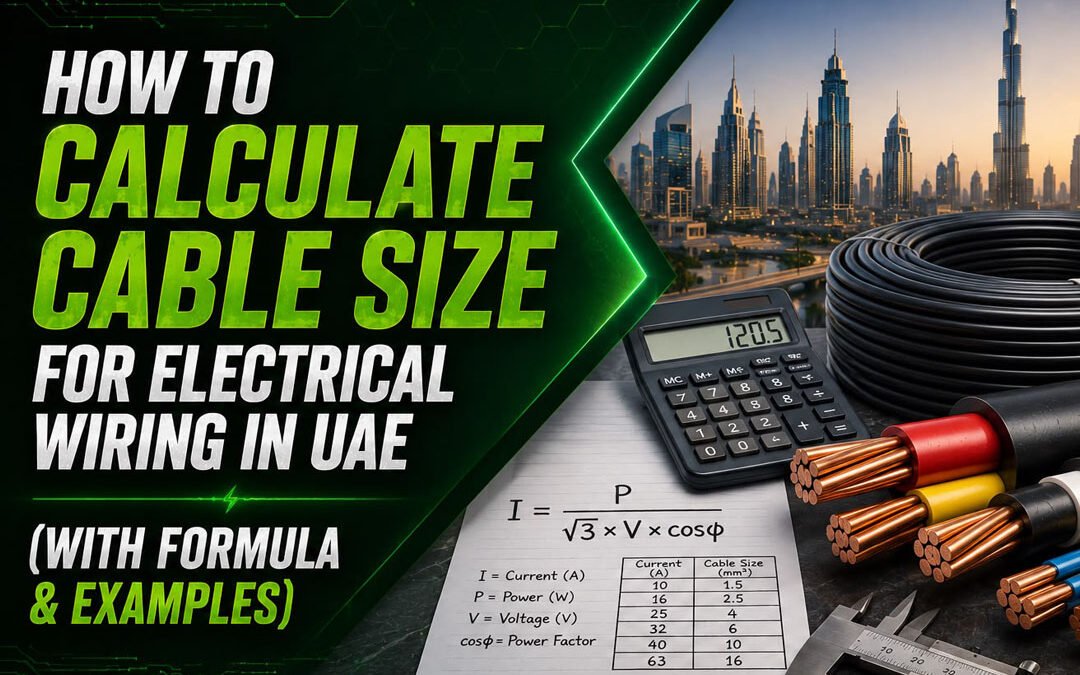
How to Calculate Cable Size for Electrical Wiring in UAE
The selection of the right size of cable is the concern of safety, efficiency and long term performance of any electrical system. The issue of correct cable sizing is even more important in the UAE, where high temperatures and the presence of heavy electrical loads are prevalent. This manual gives the fundamentals in a straightforward and practical manner.
Why Cable Size is Important?
The size of the cables influences the safety of electricity passing through a system. When the cable is too narrow, it may overheat, create a voltage drop or even be a source of fire. An appropriately sized cable ensures easy power transmission, reduced energy consumption, and safeguards appliances.
The Major Factors to be considered
1. Load Current (Ampere)
Begin by dividing the total load. Sum the total of the watts of all the devices and divide by the voltage.
Formula:
Current (A) = Power (W) ÷ Voltage (V)
This provides you with the lowest current the cable should be capable of carrying.
2. Cable Length
The length of cables increases resistance resulting in a voltage drop. With longer distances, you might require a heavier cable so as to retain efficiency.
3. Ambient Temperature
The current-carrying capacity of a cable can be decreased by the high temperatures of the UAE. When cables are placed in hot places or are exposed to the sun, they have to be oversized.
4. Installation Method
The location of the cable, either underground, within conduits, or in the open air, influences heat dissipation. Lack of ventilation implies heating up, which requires a bigger cable size.
5. Voltage Drop
In most installations, the voltage drop must not be more than 3-5 percent. An uncontrolled fall may cause equipment damage or performance loss. This is controlled by using a larger cable.
Simple procedures to determine cable size.
- Divide resistance into watts.
- Convert to current using voltage
- Standard cable capacity check charts.
- Compensate for temperature and installation conditions.
- Check that the voltage drop is within limits.
As an example, a load of 3000W on a 230 V system:
Current = 3000 ÷ 230 ≈ 13 amps
Then you would choose a cable capable of safely carrying over 13 amps, accounting for all correction factors.
Popular Cable Sizes in Use
- 1.5 sq mm – Light circuits.
- 2.5 sq mm – Power sockets
- 4 sq mm or more – Heavy equipment such as AC units.
These are however general guidelines. Never make assumptions or rely on guesses and local laws.
UAE Standards and Safety
In the UAE, electrical installations have to be guided by the authorities such as DEWA and ADDC. These standards guarantee good insulation, fire safety and efficiency. Their disregard may result in fines and insecure mechanisms.
Conclusion
Cable size calculation is not a technical matter, but a safety measure. With the load, temperature, distance, and installation method in mind, you will be able to build a solid electrical installation that will perform well even under the harsh conditions of the UAE.
In projects where precision in planning and proper electrical solutions are crucial, Acrab Cab is oriented towards providing practice and safe wiring solutions, which are aligned with local demands.