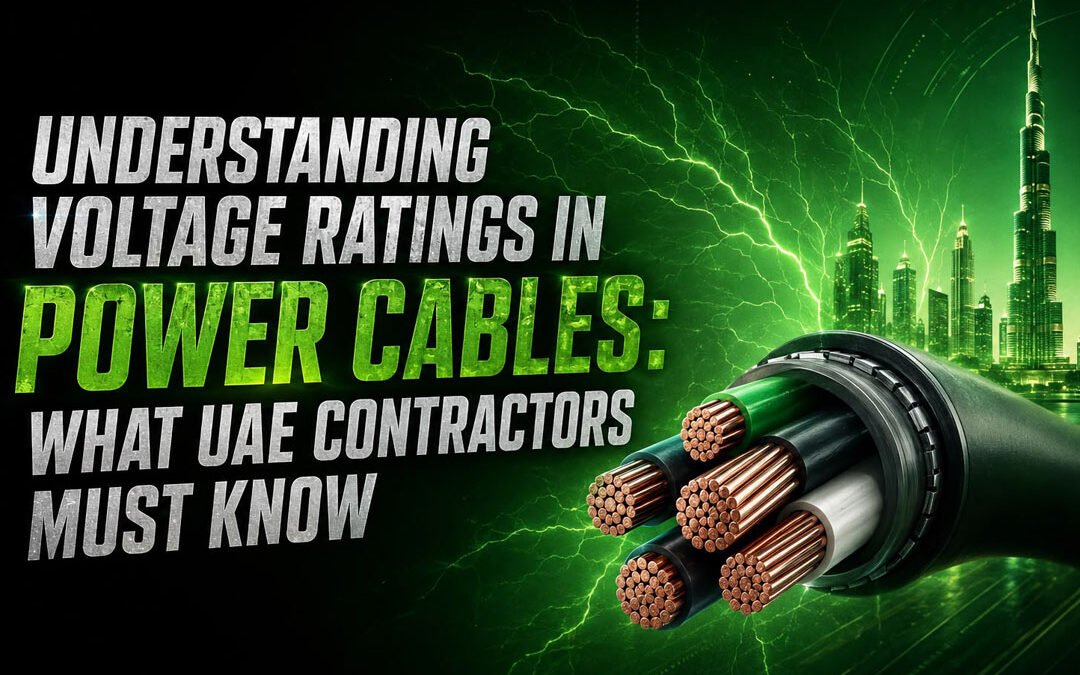
Understanding Voltage Ratings in Power Cables: What UAE Contractors Must Know
Power cables form an essential component of any electrical system, particularly in construction and infrastructure projects in the UAE. To the contractors and engineers, voltage ratings in power cables are vital in the process of making sure that safety, efficiency and electrical standards are met. When the appropriate cable rating is chosen, equipment damage, electric breakdowns, and other possible risks are avoided.
What Do Voltage Ratings of power cables constitute?
Voltage rating is the highest electrical voltage which a cable can sustain before breaking through the insulation of the cable. All power cables are built using insulation materials that can sustain a given amount of voltage.
An example of common categories of voltage is:
- Low Voltage (LV): Up to 1 kV
- Medium Voltage (MV): 1 kV to 35 kV
- High Voltage (HV): Above 35 kV
These ratings assist engineers in judging the points and manner in which the cable is to be utilized. The use of a cable of less than the necessary voltage capacity may cause insulation breakages and electrical breakages.
The importance of voltage ratings in construction projects
The electrical systems in the UAE are required to work in harsh conditions in the rapidly expanding infrastructure industry. Appropriate power cable voltage ratings can be used in order to make sure that cables can operate safely under conditions of load and environment.
Voltage rating is important because of the following reasons:
- Electrical safety: Does not allow overheating and insulation breakdown.
- Reliability of the system: Assures a constant power supply.
- Adherence to standard: International and local electrical standards.
- Equipment protection: Prevents the destruction of linked equipment.
Misuse of cables may also lead to short circuits, wastage of energy or even expensive system breakdowns.
Factors That Affect Cable Voltage Performance
A number of technical considerations determine the effectiveness of a cable in real life conditions with regard to its capacity to manage voltage.
1. Insulation Material
The largest contribution to the choice of voltage capacity is made by cable insulation. Common materials used such as XLPE (cross-linked polyethene) and PVC are highly used due to their high dielectric characteristics.
2. Environmental Conditions
Cable insulation can be influenced by high temperatures, moisture, and UV exposure, and all these factors are typical in the UAE. Contractors have to select cables that are capable of working in extreme climates.
3. Installation Method
The installation of cables underground, in conduits or on cable trays could influence their performance. The correct installation is useful in preserving the designed voltage strength of the cable.
4. Load Requirements
The electrical load which will go to the system should be calculated properly. Cables must never be undersized with respect to voltage and current carrying capacity.
The Regulatory Environment of the UAE
Electrical installations in the UAE have to be within accepted standards like the International Electrotechnical Commission (IEC) standards. These criteria stipulate testing activities, insulation criteria, and the safety margin of power cables.
Conclusion
Voltage ratings in power cables are important to all contractors handling electrical systems. Proper selection of cables enhances safety, efficient delivery of power and also contributes to the long run system reliability. Contractors can minimize risks and guarantee the successful results of the project by taking into account the type of insulation, conditions of the environment, installation practices, and the load requirements.
Those who want to know more about the reliable cable solutions and technical information in the electrical sector can visit Acrab Cab where information and resources will be provided on the power cables and the wiring systems that are applied in the contemporary infrastructure developments.