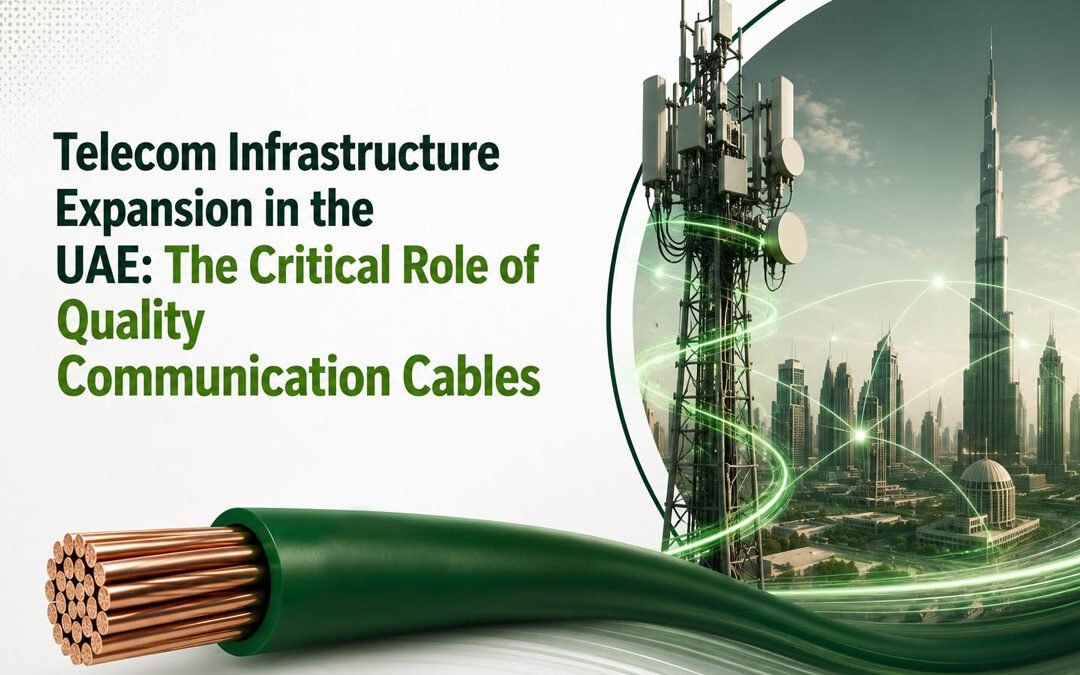
Telecom Infrastructure Expansion in the UAE: The Critical Role of Quality Communication Cables
The UAE has been rapidly investing in its telecom ecosystem to enable smart cities, digital services, cloud computing and fast connectivity. Communication cables are one of the key components in all telecom infrastructure projects, as the demand for reliable communication networks is increasing day by day. Whether it is a fibre-optic backbone, data centre, business network or home internet connection, quality communication cables can help provide stable performance, increased data transfer speeds and future-proof reliability.
Why Communication Cables are Important in Telecom Infrastructure?
Today’s telecom equipment relies on communication cables to carry voice, video and data signals with little loss or degradation. Rubber gloves or poor-quality equipment can make networks less efficient, more costly to maintain, and more susceptible to service interruptions. Premium communication cables, on the contrary, offer greater signal integrity, higher bandwidth, and greater durability, even in tough outdoor applications.
The UAE’s commitment to digital transformation, with the launch of smart city projects and the rollout of 5G, has created a demand for reliable telecom infrastructure. The UAE’s investment in digital transformation, such as its smart city initiatives and 5G rollout, has driven a greater need for dependable telecom infrastructure. All network upgrades require cables that meet international standards and remain stable over time.
Communication Cable Supports the UAE’s Digital Growth
The UAE is also making significant investments in cutting-edge telecom technology to enhance digital connectivity and communications in various sectors. The government’s initiatives indicate that the country remains one of the global leaders in mobile broadband and fibre-optic coverage. Maintaining network stability and supporting increased network data traffic depend on these developments, which are enabled by communication cables.
Reliable communication cables are also vital components of the network that links hospitals, schools, industrial facilities, airports, financial institutions, and residential communities. With the use of cloud-based apps and Internet of Things (IoT) devices, reliable telecom infrastructure is needed even more than ever.
Select the Right Communication Cables
Communication cables need to be chosen based on the project’s needs. For high-speed data transmission over long distances, fibre-optic communication cables are the preferred choice, while for structured cabling systems and local networks, copper communication cables are still used. Different types of cables should be selected based on factors such as environmental conditions, bandwidth requirements, installation methods, and future scalability.
Of course, high-quality communication cables also have superior insulation, shielding, and water, heat, and mechanical resistance. These features provide greater network reliability and lower repair/replacement costs.
Benefits of Telecom Networks
High-quality communication cables help make overall telecom infrastructure more effective. Stable connections minimise downtime, improve user experience and make network maintenance easy. Quality communication cables can also accommodate future technology upgrades without replacing all the infrastructure, making them a cost-efficient investment when expanding telecom networks.
Conclusion
Communication cables will continue to be the backbone of robust telecom infrastructure in the UAE as it strives to build a digitally connected economy. Investing in durable, standards-based cable options can help build networks that can keep pace with future innovations and greater connectivity needs.
Acrab Cab provides communication cable solutions tailored to the UAE’s evolving telecom infrastructure, offering organisations dependable solutions that align with their needs.
FAQs
1. Why are communication cables important for telecom infrastructure?
Communication cables carry voice, data, and internet signals between network devices. High-quality cables improve transmission speed, reduce signal loss, enhance reliability, and support the growing demands of modern telecom infrastructure projects.
2. Why is fibre optic cable widely used in the UAE?
Fibre optic cables provide faster data transmission, higher bandwidth, low latency, and minimal signal loss. They are ideal for supporting 5G networks, smart cities, cloud computing, and digital transformation initiatives.
3. How do quality communication cables reduce maintenance costs?
Quality communication cables are designed with durable insulation and strong protective layers. They resist environmental damage, reduce failures, require fewer repairs, and extend the overall lifespan of telecom infrastructure.
4. What factors should be considered when selecting communication cables?
Important factors include bandwidth requirements, transmission distance, installation environment, cable durability, compliance with industry standards, scalability, and compatibility with existing telecom infrastructure and future network expansion.
5. How do communication cables support smart city development?
Communication cables connect digital systems, surveillance, transportation, utilities, healthcare, and public services. Reliable cable infrastructure enables secure, fast, and uninterrupted communication necessary for efficient smart city operations.