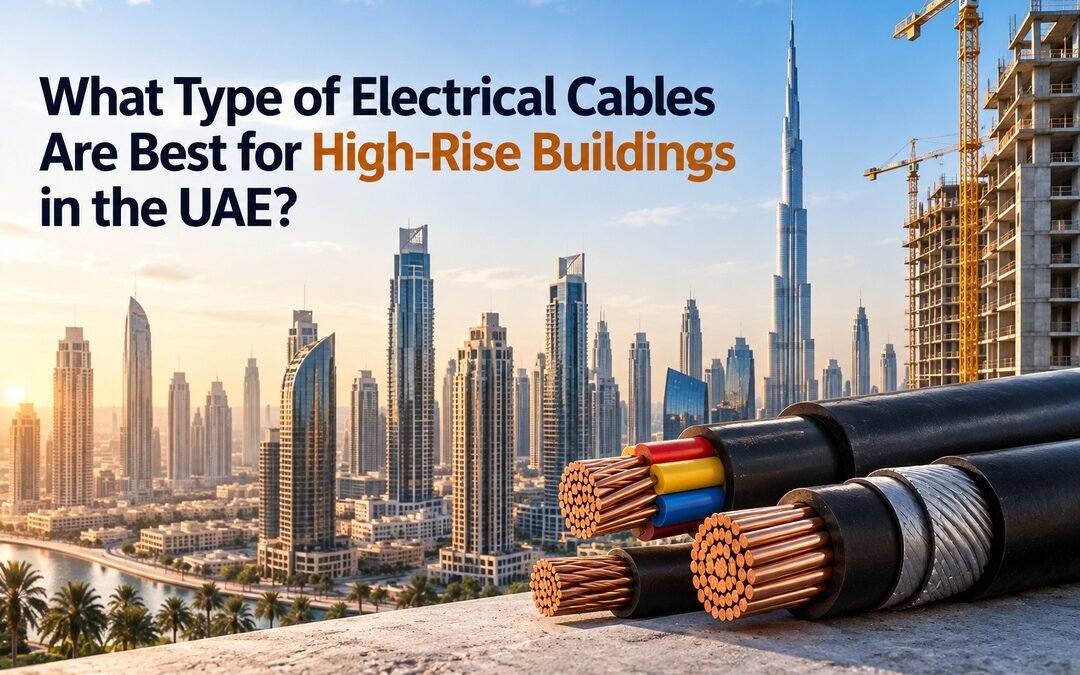
High-rise buildings have complex electrical systems that must operate safely across multiple floors, service areas, emergency systems, and equipment rooms. In the UAE, cable selection is especially important because electrical installations must consider fire safety, heat, installation conditions, and applicable authority requirements. The Dubai Fire and Life Safety Code classifies buildings with occupiable or usable spaces above 23 metres as high-rise structures.
For such projects, the best electrical cables are generally those that combine suitable current-carrying capacity with strong insulation, fire performance, low smoke emission, and resistance to flame propagation. Depending on the application, XLPE-insulated, LSZH/LSHF, armoured, and fire-resistant cables can all have a role. Acrab Cab can help project teams select suitable cable solutions according to the building’s electrical design and application requirements.
Why Cable Selection Matters in UAE High-Rise Buildings
Electrical cables in tall buildings may run through shafts, ceilings, service rooms, basements, and other enclosed spaces. A cable failure can affect several floors and, in a fire, smoke and toxic gases can create additional risks.
Important considerations include:
- Electrical load and current capacity
- Voltage drop over long cable runs
- Operating temperature
- Fire resistance and flame propagation
- Smoke and halogen emissions
- Mechanical protection
- Installation method
- Compliance with applicable UAE and project specifications
Dubai’s electrical design guidance also emphasizes proper cable sizing based on the project, supply type, installation route, containment, support systems, and applicable requirements.
Best Types of Electrical Cables for High-Rise Buildings
1. XLPE Insulated Cables
XLPE cables are commonly considered for power distribution because their insulation provides good thermal and electrical performance. They can be used for feeders and distribution circuits where the design calls for them.
For high-rise applications, XLPE cables may be combined with suitable sheathing and armouring depending on the installation environment.
2. LSZH or LSHF Cables
Low Smoke Zero Halogen (LSZH) or Low Smoke Halogen Free (LSHF) cables are particularly useful in areas where fire safety and smoke control are important.
During a fire, conventional materials can produce dense smoke and corrosive gases. LSZH cables are designed to reduce these hazards. Dubai’s Building Code, for example, specifies halogen-free requirements for certain permanently installed ICT cabling and references relevant fire-performance classifications.
3. Fire-Resistant Cables
Fire-resistant cables are used for circuits that need to continue operating during a fire. These may include:
- Fire alarm systems
- Emergency lighting
- Smoke control systems
- Fire pumps
- Emergency communication systems
- Other life-safety equipment
The UAE Fire and Life Safety Code FAQ states that circuits required for notification appliances can require a 2-hour fire-rated circuit-integrity cable or an equivalent protected system, subject to the applicable conditions.
4. Armoured Cables
Armoured cables provide additional mechanical protection and can be suitable for applications where cables may face physical damage or require robust protection.
For high-rise projects, their use depends on the route, containment arrangement, environment, and electrical design. They are not automatically the best choice for every circuit.
Cable Selection by Application
Application | Commonly Suitable Cable Type |
Main power distribution | XLPE insulated power cables |
Sub-main distribution | XLPE/LSHF or suitable armoured cables |
Final circuits | PVC/XLPE insulated copper cables, as specified |
Fire alarm systems | Fire-resistant, low-smoke cables |
Emergency lighting | Fire-resistant/LSZH solutions where specified |
Critical life-safety circuits | Enhanced fire-resistant cables or approved protected systems |
Data and communication | LSZH/halogen-free cables |
The exact specification should always be confirmed against the project’s electrical consultant requirements and the relevant UAE authority requirements.
What Standards Should Be Considered?
Cable selection should not be based only on conductor size or insulation material. Relevant standards may include IEC and BS standards covering conductor construction, voltage ratings, flame propagation, smoke emission, halogen emissions, and fire resistance.
For example, IEC 60502-1 is used for certain low-voltage power cables, while standards such as IEC 60332, IEC 61034 and IEC 60754 address different aspects of cable fire behaviour, smoke and gases. Certified cable ranges in the region demonstrate how these standards can apply to LSZH and low-voltage power cable products.
How to Choose the Right Cable for a High-Rise Project
Before purchasing electrical cables, project teams should evaluate:
- Electrical load: Select the conductor size according to the calculated load.
- Voltage drop: Consider the length of vertical and horizontal cable runs.
- Installation method: Tray, conduit, shaft, buried installation, and other methods can affect cable selection.
- Fire requirements: Identify circuits that must remain operational during a fire.
- Environmental conditions: Consider temperature, moisture, chemicals, and potential physical damage.
- Authority requirements: Check the applicable DEWA, Civil Defence, municipality, or other project requirements.
- Certification: Verify test reports, standards, approvals, and technical datasheets before procurement.
Conclusion
The best electrical cables for high-rise buildings in the UAE are not determined by one cable type alone. XLPE cables, LSZH/LSHF cables, armoured cables, and fire-resistant cables can each be appropriate for different parts of a building’s electrical system. The right choice depends on electrical load, installation conditions, fire-safety requirements, cable route, and applicable UAE standards.
For reliable cable selection and project-specific requirements, Acrab Cab can be considered for quality-focused electrical cable solutions suitable for demanding building applications.
FAQs
1. Which cable is commonly used for high-rise power distribution?
XLPE-insulated power cables are commonly considered for power distribution because of their electrical and thermal performance. The final selection depends on load calculations and project specifications.
2. Are LSZH cables suitable for high-rise buildings?
Yes. LSZH cables can be valuable in enclosed areas where reducing smoke and halogen emissions is important, particularly for specified communication and electrical applications.
3. When are fire-resistant cables required?
They are generally used for critical circuits that must continue functioning during a fire, such as fire alarms, emergency lighting, and other life-safety systems, according to the applicable design and code requirements.
4. Are armoured cables necessary in every high-rise building?
No. Armouring depends on the installation environment and required mechanical protection. The consultant should determine whether armoured construction is appropriate.
5. What should be checked before buying electrical cables in the UAE?
Check conductor size, voltage rating, insulation, fire performance, applicable IEC/BS standards, test certificates, installation requirements, and relevant authority or project approvals.