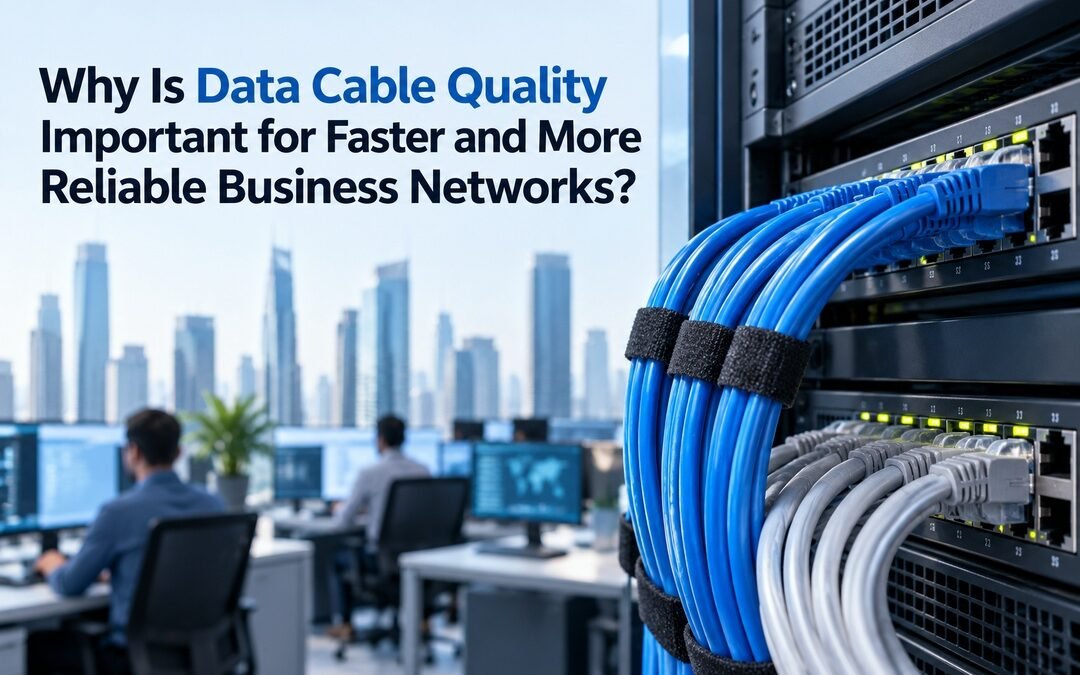
A business network is only as reliable as the infrastructure supporting it. While companies often focus on high-speed internet plans, routers, and switches, the quality of the data cable connecting these devices is equally important. Poor-quality cables can cause slow transfers, connection drops, interference, and network errors, even when other networking equipment is capable of delivering high speeds. Good-quality cables provide stable signal transmission and help businesses get the performance they expect from their network. For modern offices using cloud applications, video conferencing, VoIP, shared servers, and large file transfers, choosing the right cable is therefore a practical investment. Acrab Cab offers quality-focused cabling solutions designed to support dependable business connectivity.
How Does Data Cable Quality Affect Network Performance?
A network cable carries electrical signals between computers, switches, servers, access points, and other devices. Its construction, conductor quality, insulation, twisting, and shielding can influence how effectively those signals travel.
A poor-quality cable may introduce greater signal loss or interference, resulting in:
- Slower data transfer
- Unstable network connections
- Higher error rates
- Frequent disconnections
- Reduced performance over longer distances
- Difficulty supporting higher network speeds
For example, Cat6 can support 1 Gbps Ethernet up to 100 metres, while 10GBASE-T over Cat6 is generally limited to shorter distances. Cat6A can support 10GBASE-T up to 100 metres under the relevant standards.
Why Is Good Data Cable Important for Business Networks?
1. Supports Faster Data Transfer
Businesses increasingly depend on large files, cloud platforms, online meetings, video systems, and real-time applications. A suitable data cable helps the network maintain the required transmission speed between connected devices.
For instance, Cat6A offers a 500 MHz bandwidth specification and is designed to support 10 Gbps transmission over the full 100-metre channel.
2. Reduces Signal Interference
Electrical and network cables installed close together can experience crosstalk. This unwanted signal interference can affect network performance, particularly at higher transmission speeds.
Better-quality cables are designed with appropriate twisting, construction, and, where required, shielding to control interference. Cat6A, for example, provides improved protection against alien crosstalk compared with lower categories.
3. Improves Network Reliability
A business cannot afford regular connectivity problems. Network interruptions can affect communication, cloud access, transactions, customer service, and employee productivity.
Quality cabling provides consistent signal transmission and reduces the chances of problems caused by inadequate cable construction or unsuitable specifications.
4. Helps Support Future Network Upgrades
Network infrastructure is usually installed inside walls, ceilings, floors, and cable trays. Replacing it later can be expensive and disruptive.
Selecting an appropriate cable category during installation can provide additional capacity for future upgrades. For businesses planning higher-speed networking, Cat6A can offer greater headroom than Cat6.
Data Cable Quality: Cat5e vs Cat6 vs Cat6A
Cable Category | Typical Bandwidth | 1 Gbps | 10 Gbps |
Cat5e | 100 MHz | Up to 100 m | Not standard |
Cat6 | 250 MHz | Up to 100 m | Up to about 55 m |
Cat6A | 500 MHz | Up to 100 m | Up to 100 m |
The exact performance also depends on the complete installation, including connectors, patch panels, equipment, cable length, and installation practices.
What Should Businesses Check Before Buying Data Cables?
Choosing a cable only because it is inexpensive can create problems later. Businesses should consider:
- Cable category: Select Cat5e, Cat6, Cat6A, or another suitable category according to network requirements.
- Conductor quality: Check whether the cable construction meets the required specifications.
- Shielding: Consider shielded cables where the installation environment has significant interference concerns.
- Required distance: Cable performance varies with speed and distance.
- Installation quality: Poor termination, excessive bending, or unsuitable installation can reduce performance.
- Future requirements: Consider planned upgrades rather than only today’s network speed.
How Can Quality Data Cables Improve Business Productivity?
A stable network allows employees to access cloud applications, transfer documents, communicate through video calls, use VoIP systems, and access shared resources without unnecessary interruptions.
For example, imagine an office transferring large design files between workstations and a server. If the cabling cannot reliably handle the required speed, employees may experience delays even though the server and switch are capable of faster performance. Upgrading the underlying cabling can help remove that infrastructure bottleneck.
Why Choose Acrab Cab for Business Networking Needs?
Choosing dependable cabling is an important part of building a reliable network. Acrab Cab focuses on providing data cable solutions suitable for businesses that need stable connectivity and consistent network performance.
The right cable can help businesses achieve better transmission quality, reduce avoidable network issues, and prepare their infrastructure for increasing data requirements.
Conclusion
Data cable quality is important for faster and more reliable business networks because cabling directly affects signal transmission, interference control, connection stability, and achievable network speeds. Businesses should therefore look beyond price and select cables according to speed, distance, installation environment, and future requirements. From everyday office connectivity to high-speed applications, choosing an appropriate cable category can make the network more dependable. With quality-focused solutions from Acrab Cab, businesses can build a stronger foundation for their networking infrastructure.
FAQs
1. Does data cable quality affect internet speed?
Yes. Poor or unsuitable cabling can limit network performance, especially when connected devices support higher speeds.
2. Is Cat6 better than Cat5e for business networks?
Cat 6 provides higher bandwidth and greater performance headroom, making it a useful choice for many modern business networks.
3.Is Cat6A suitable for 10 Gbps networking?
Yes. Cat6A is designed to support 10GBASE-T up to 100 metres under applicable standards.
4.Can poor-quality cables cause network disconnections?
Yes. Signal problems, interference, damaged cables, or poor connections can contribute to unstable connectivity.
5.Why is shielding important in data cables?
Shielding can help reduce the impact of electromagnetic interference and crosstalk in environments where such interference is a concern.